Fasanara Digital + Glassnode: Q4 2025 Institutional Market Perspectives
With Bitcoin retracing from recent highs and global liquidity tightening, our collaborative report with Fasanara Digital outlines how market structure is shifting in Q4, and the implications for institutional investors.

Digital assets are moving through a structurally important phase of the cycle. Bitcoin has pressed through a three-year expansion driven by deep spot liquidity, historic capital inflows, and the pull of regulated ETF demand. The market’s centre of gravity has shifted: flows are consolidating, execution venues are maturing, and derivatives infrastructure is absorbing larger shocks with increasing resilience.
Drawing on Glassnode’s data and Fasanara’s trading perspective, our latest research report charts how market structure has evolved through 2025. We examine how liquidity has reorganised across spot, ETFs, and futures; and how stablecoins, tokenisation, and off-exchange settlement are reshaping the movement of capital. Together, these developments outline a market architecture that is materially different from previous cycles, and still evolving.
Key Highlights
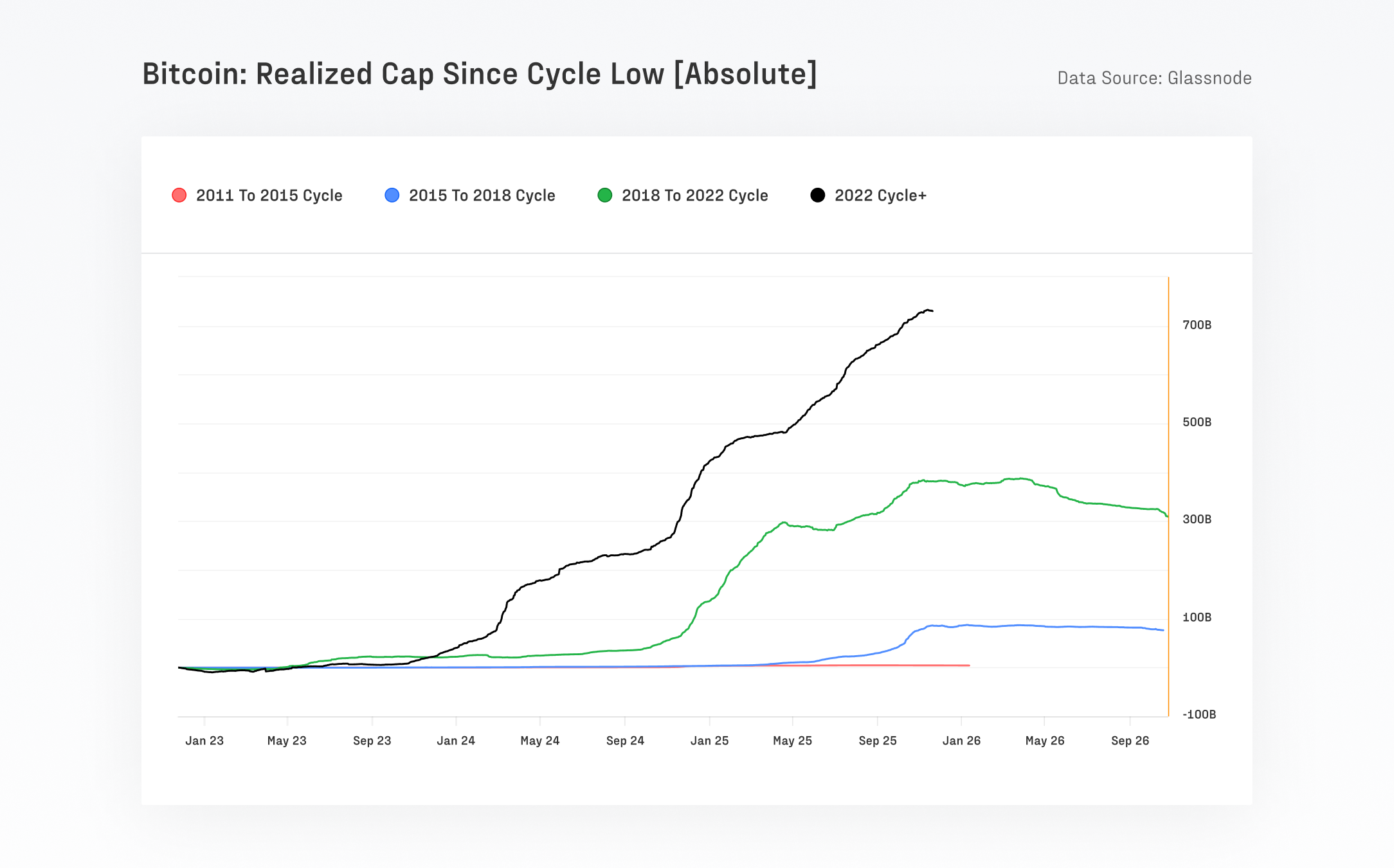
- Bitcoin has attracted > $732B in new capital – more than all previous cycles combined, lifting its Realized Cap to ~$1.1T with +690% price gain.
- The top asset's long-term volatility has nearly halved, falling from 84% to 43%, reflecting growing market depth and institutional participation.
- Over the last 90 days, Bitcoin settled ~$6.9T in value, on par or above Visa and Mastercard’s quarterly volumes. Activity migrates off-chain due to venue shift to ETFs and brokers, but Bitcoin and stablecoins dominate on-chain settlement.
- ETF trading volumes have increased from sub-$1B baseline to >$5B/day, with peaks above $9B/day (e.g., post-Oct 10 deleveraging).
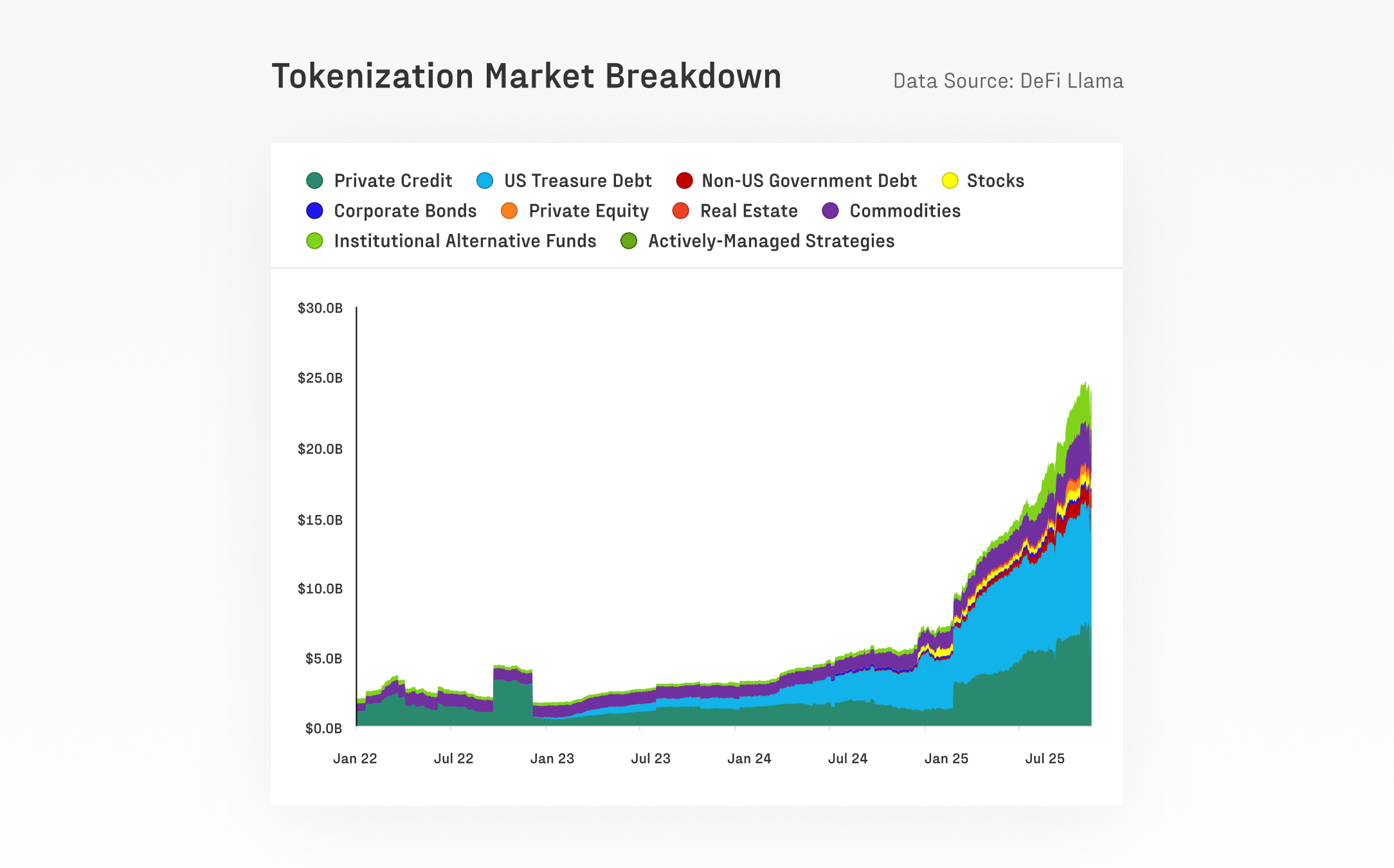
- Tokenized real-world assets' (RWAs) value grew from $7B to $24B in a year. A key advantage is their low correlation with traditional crypto assets, increasing stability and capital efficiency in DeFi.
- The decentralized perpetual sector has experienced an explosive, yet sustained growth: DEX perp share increased from ~10% to ~16-20%, while monthly perpetual volume surpassed $1T.
- VC activity remains closely aligned with altcoin cycles, with concentration in established, high-profile sectors such as exchanges, core infrastructure, and scaling solutions.
This cycle is Bitcoin-led, spot-driven, and institutionally anchored
Since November 2022, Bitcoin dominance increased from 38.7% → 58.3%, marking a shift back to high-liquidity majors in this cycle, while altcoins retreat. Ethereum's dominance has declined to 12.1%, extending its multi-year trend of underperformance relative to Bitcoin following the 2022 merge.
Bitcoin attracted $732B in new capital from cycle low to peak — more than all prior cycles combined. Ethereum and the broader altcoin sector also appreciated strongly, peaking at over +350% gains, but did not outperform Bitcoin as in prior cycles.
Deeper liquidity and lower long-term volatility, but leverage shocks persist
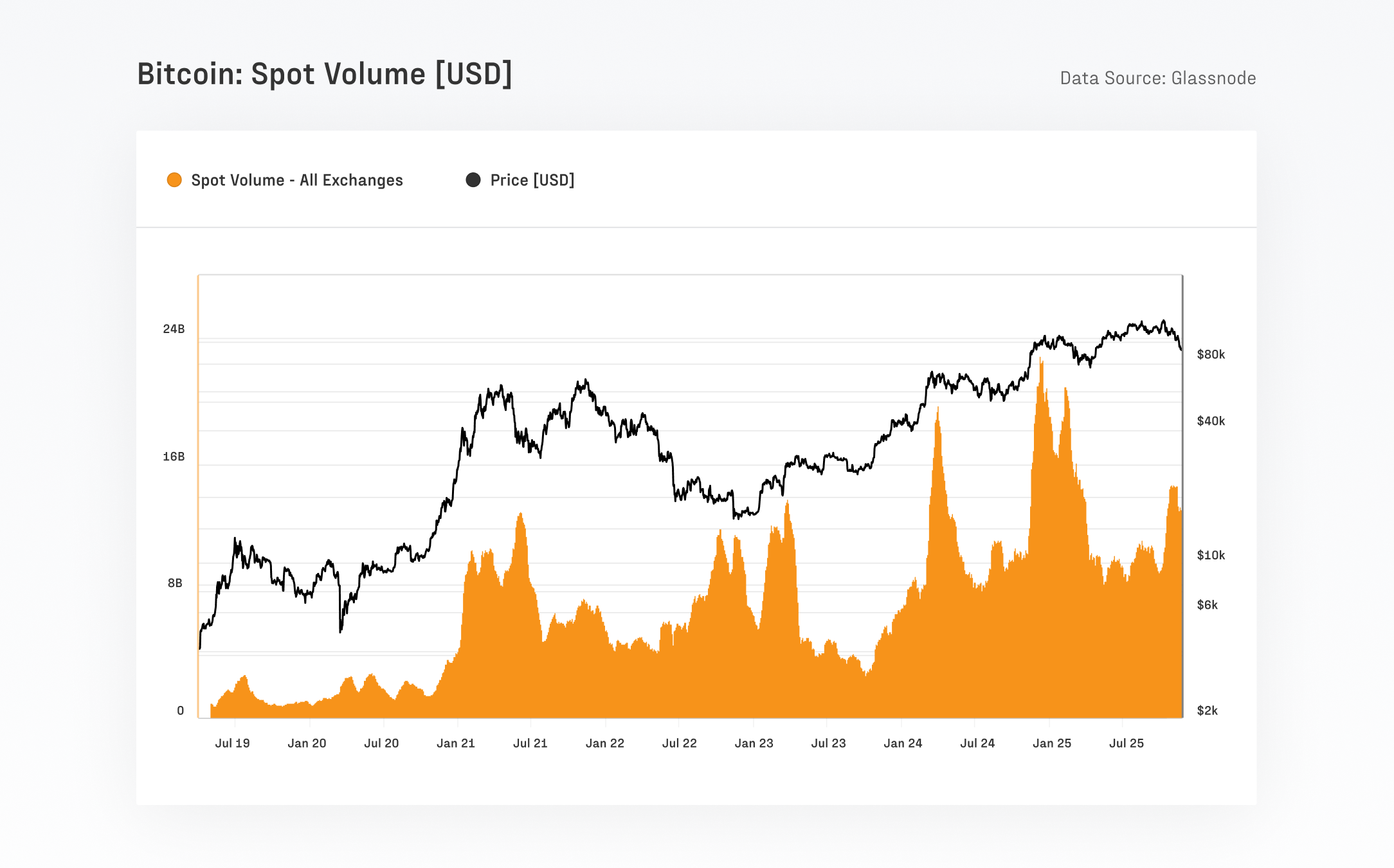
Bitcoin’s market structure has strengthened materially, with spot volumes rising from $4B–$13B in the prior cycle to $8B–$22B/day today. Long-term volatility has continued to decline, with 1-Year Realized Volatility falling from 84.4% to 43.0%. Meanwhile, futures activity expanded to a record $67.9B in open interest, with CME accounting for roughly 30% of total OI, a clear institutional footprint.
Activity migrates off-chain, but Bitcoin and stablecoins dominate on-chain settlement
Bitcoin’s Number of Active Entities has declined from roughly 240k to 170k per day following the approval of U.S. spot ETFs, reflecting a shift in activity toward brokerage and ETF venues rather than a collapse in network usage.
Despite this migration, Bitcoin has settled around $6.9T in value over the past 90 days, placing it on par with, or above, the quarterly volumes processed by networks such as Visa and Mastercard. When adjusted for internal movements using Glassnode’s entity-adjusted heuristics, economic settlement still reaches approximately $0.87T per quarter, or $7.8B per day.
Alongside this, stablecoins continue to underpin liquidity across the digital asset ecosystem. The aggregate supply of the top five stablecoins has reached a record $263B. The combined transfer volume of USDT and USDC averages roughly $225B per day, with USDC exhibiting notably higher velocity, a pattern consistent with more institutional and DeFi-oriented flows.
Tokenized assets are expanding the market’s financial rails
Tokenized real-world assets have expanded dramatically over the past year, rising from $7B to $24B in value. Ethereum remains the primary settlement layer for this activity, now hosting roughly $11.5B in tokenized assets. The largest individual product, BlackRock’s BUIDL, has grown to $2.3B, more than quadrupling year-to-date.
Alongside these inflows, tokenized funds have emerged as one of the fastest-growing categories, opening new distribution channels for asset managers. This reflects the broadening range of assets being brought on-chain and the increasing institutional adoption of tokenization as a distribution and liquidity channel.
Read the full report
To get a structured walkthrough of today’s market across 35 pages from an institutional vantage point, you can download your copy of the report. It combines cycle-level context with microstructure detail on spreads, collateral, and liquidations, as well as analysis of stablecoins, tokenized assets, treasuries, and off-exchange settlement.
Disclaimer: This report is for informational and educational purposes only. The analysis represents a limited case study with significant constraints and should not be interpreted as investment advice or definitive trading signals. Past performance patterns do not guarantee future results. Always conduct thorough due diligence and consider multiple factors before making investment decisions.
